When nutrients meets systems

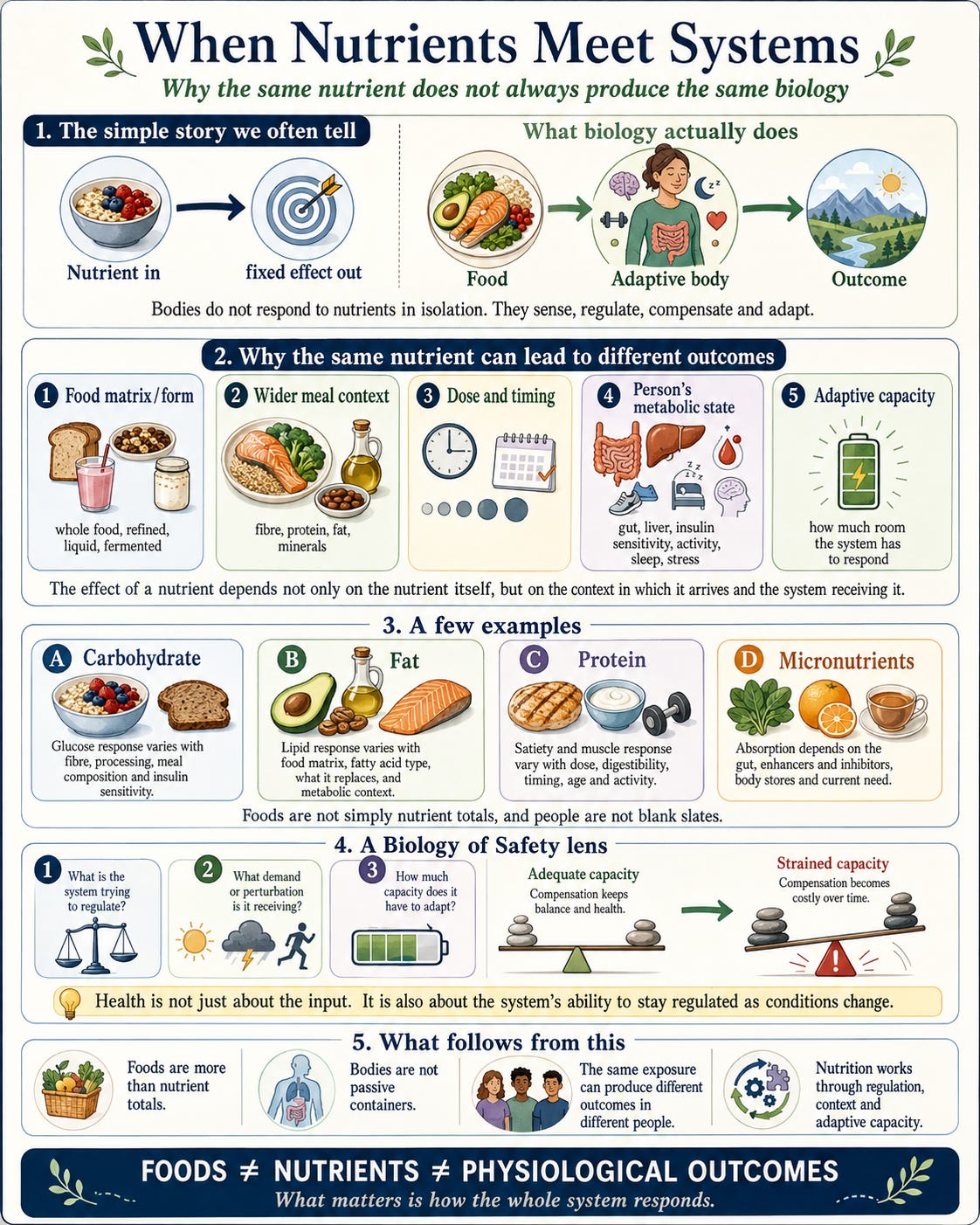
Nutrition science often has to simplify. We need messages that can be communicated clearly, guidelines that can be applied across populations, and explanations that are usable in the clinic. Saturated fat raises LDL cholesterol. Fibre lowers cholesterol. Excess energy contributes to weight gain. These statements are useful because they describe real patterns. The problem comes when a population-level association is mistaken for a complete description of what is happening biologically.
The body does not receive nutrients as isolated inputs and then produce fixed outputs. It receives food, in a particular physical structure, alongside other nutrients and compounds, into a biological system that is already in a particular state. That system senses, responds, compensates and adapts. The effect of what we eat therefore depends not only on the nutrient itself, but on the form in which it arrives, the wider food matrix, the metabolic context and the regulatory capacity of the person receiving it.
Cholesterol metabolism is a useful example because it makes this particularly visible.
The simplest version of the story is that eating cholesterol increases cholesterol in the blood. Yet this is not what happens in a straightforward way. Cholesterol entering the gut is only one contribution to a much larger regulated system. The body also synthesises cholesterol, secretes cholesterol into bile, reabsorbs some of it from the intestine, packages lipids into lipoproteins and continually removes circulating particles through receptors in the liver.
If cholesterol absorption from the gut changes, the body can alter cholesterol synthesis. If hepatic cholesterol availability changes, LDL receptor activity can change. The liver can alter how much lipid it exports in VLDL particles, which are progressively remodelled in the circulation and can ultimately contribute to the LDL pool. What appears on a blood test as LDL cholesterol is therefore not simply a reflection of how much cholesterol someone has eaten. It is the result of a balance between production, transport and clearance.
Two people can eat the same diet and produce different LDL responses because the system receiving the diet is different.
One may absorb relatively little intestinal cholesterol and compensate readily by altering endogenous synthesis and clearance. Another may absorb more, produce more apoB-containing particles, clear LDL less efficiently, or have a metabolic environment in which hepatic lipid handling is already under greater pressure. Genetics, insulin resistance, liver fat, body composition, medication, age and many other factors can shift different parts of the system.
This does not make dietary exposure irrelevant. It means that exposure is only one part of the causal pathway.
The same problem appears when we talk about saturated fat.
The conventional statement that saturated fat raises LDL cholesterol is broadly useful and supported at population level, particularly when saturated fat replaces unsaturated fat. But it can become misleading if it is interpreted as though every gram of saturated fat has an identical biological effect regardless of where it comes from.
Fermented dairy provides an interesting challenge to that assumption. Foods such as cheese can contain substantial amounts of saturated fat, yet their effect on LDL cholesterol is not always what would be predicted from their saturated fat content alone. Studies comparing cheese with butter, for example, have often found a smaller LDL response to cheese despite apparently similar saturated fat exposure.
That does not mean saturated fat suddenly stops existing when it is inside cheese. It suggests that the biological effect of a nutrient cannot always be separated from the structure in which it is consumed.
This is the idea of the food matrix. Cheese is not simply saturated fat with some protein added. Its fats are contained within a physical structure alongside calcium, proteins, phospholipids, fermentation products and other components. That structure influences digestion, nutrient release, bile acid handling and the amount of fat ultimately absorbed. Fermentation can alter the chemical environment further. The body therefore does not encounter “saturated fat” in the abstract. It encounters a particular food.
This matters because biology responds to the whole perturbation.
Nutrition has historically been very good at taking food apart. We identify vitamins, minerals, amino acids, fatty acids and bioactive compounds, then study their individual effects. This reductionist approach has been enormously productive. It allowed us to identify deficiency diseases, understand metabolic pathways and develop treatments that have transformed health.
But reductionism becomes limiting when the part is treated as though it explains the behaviour of the whole system.
A gram of saturated fat is chemically a gram of saturated fat, but the physiological consequences of consuming it are shaped by what surrounds it, how it is digested, what it replaces in the diet and what is happening metabolically in the person eating it. The same applies to carbohydrate, protein and many other components of food. Food is not simply the sum of its nutrient labels.
Nor is the body a passive container receiving those nutrients.
This is where the Biology of Safety offers a useful way of thinking. It is not proposing a new mechanism of cholesterol metabolism. The mechanisms already exist and are well described. The contribution is to shift attention towards the behaviour of the system as a whole.
The question becomes not only, “What does this nutrient do?” but, “What is the system trying to regulate, what demand has been placed upon it, and how much capacity does it have to adapt?”
Biological systems constantly compensate for variation. We eat different amounts from one day to the next. Macronutrient composition changes. Physical activity changes. Sleep changes. Illness, stress, hormonal state and energy requirements change. Despite this, many physiological variables remain within surprisingly narrow ranges because the organism continually adjusts.
That flexibility is part of health.
In the Biology of Safety, health is not understood simply as maintaining a particular number. It is partly the capacity to remain regulated while conditions change. A resilient metabolic system can absorb considerable variation in dietary input because multiple regulatory mechanisms can adjust around it.
But compensation has limits.
A system already managing insulin resistance, hepatic fat accumulation, chronic inflammation or altered lipid clearance may have less regulatory headroom. It can still adapt, but the strategies available to it may become increasingly costly. VLDL production may rise. LDL particles may remain in circulation for longer. Glucose regulation may require progressively higher insulin concentrations. A laboratory value can remain apparently acceptable for some time because considerable biological work is being done behind the scenes to keep it there.
This is an important distinction. Successful compensation in the short term does not necessarily mean absence of biological cost.
The same principle appears throughout physiology. Blood glucose can remain normal while insulin concentrations rise. Blood pressure can be maintained through increasing sympathetic and renal compensation. Energy balance can be defended through changes in hunger, expenditure and behaviour. The organism prioritises continued viability, but the route it uses to maintain stability can eventually contribute to disease.
This is why linear explanations in nutrition are so attractive and so often incomplete.
We want to say that nutrient X causes outcome Y. Sometimes that shorthand is necessary. But between X and Y sits an adaptive organism.
The effect of an exposure therefore depends partly on the state of the receiving system.
This does not require abandoning population guidance or pretending that every nutritional question is infinitely individual. Population evidence remains essential. If replacing saturated fat with unsaturated fat lowers cardiovascular risk across large groups, that matters. If fibre intake is consistently associated with better metabolic and gastrointestinal outcomes, that matters too.
The point is not that general recommendations are wrong. It is that they describe averages across adaptive systems.
Understanding that distinction may actually make nutrition science easier to reconcile rather than harder. It helps explain why apparently contradictory findings can coexist. A nutrient can have a predictable average effect while still producing substantial variation between individuals and between food sources. A dietary pattern can be beneficial overall even when one of its components appears theoretically unfavourable in isolation. A food can contain a nutrient associated with risk without producing the same physiological response as another food containing an equivalent amount.
The system integrates all of it.
Perhaps this is why nutrition becomes distorted so easily in public discussion. Individual nutrients offer simple villains and simple solutions. Fat was the problem, then carbohydrate, then sugar, then seed oils, then ultra-processed food. Each explanation contains some truth, but each becomes misleading when it tries to account for biology through a single input.
Human metabolism is not organised around our nutritional categories.
It is organised around regulation.
The liver does not know that a food has been classified as “good” or “bad”. It responds to substrates, hormones, signalling molecules, energy availability and the state of the wider organism. The intestine does not simply absorb what enters it. Absorption, secretion, microbial metabolism and signalling are dynamic processes. Adipose tissue is not merely a storage depot. Muscle is not simply an energy consumer. These tissues communicate continually within a regulatory network.
Seen this way, food is not merely a collection of nutrients, and health is not merely the avoidance of undesirable inputs.
The more interesting question is what happens when a particular input meets a particular system.
That does not make nutrition unknowable. It makes it biological.