Why capacity matters

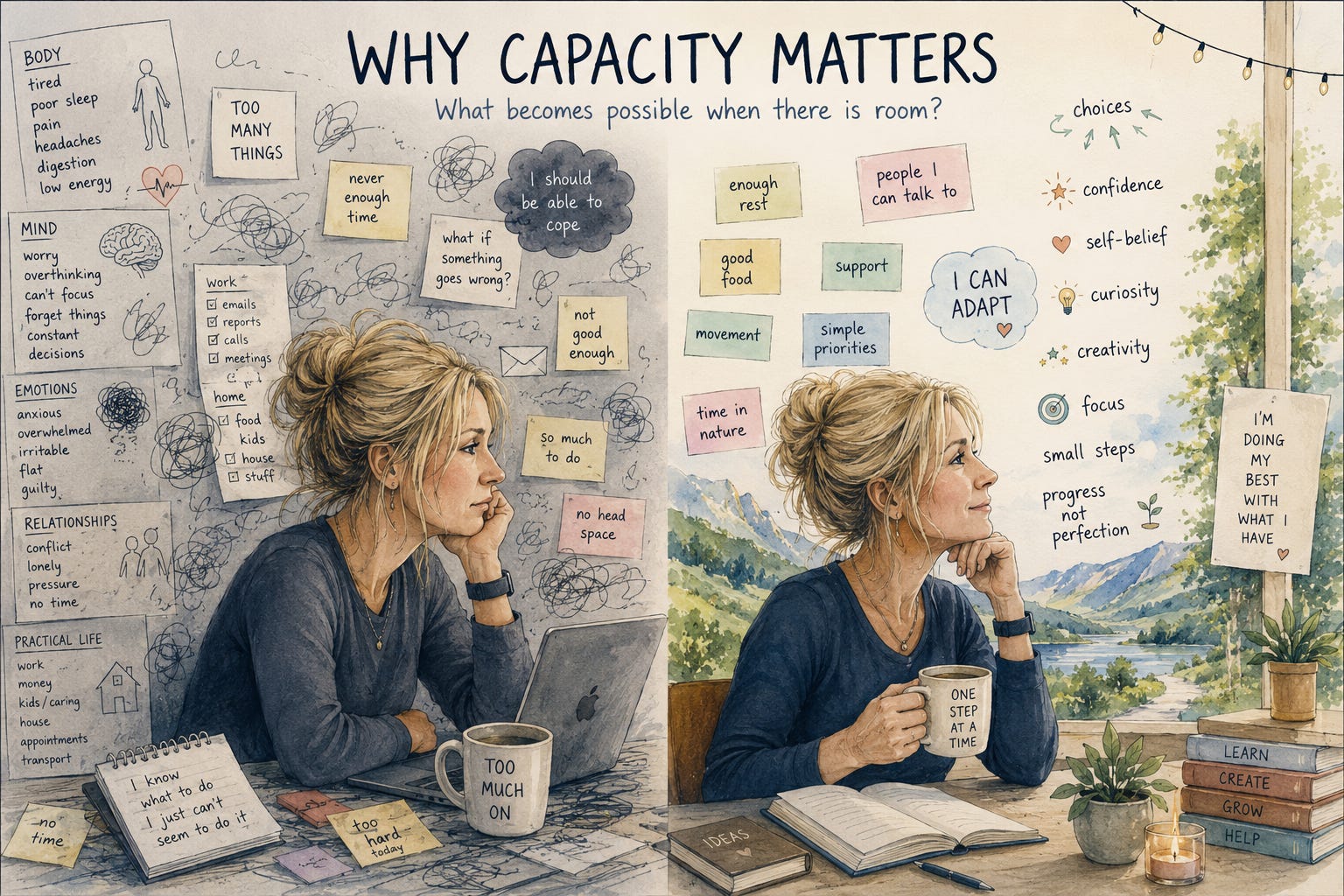
I have been thinking a lot about capacity recently, partly because I can see so clearly how much my own has changed at different points in my life.
There have been times when I have been able to do the things that absolutely needed doing, including working and functioning perfectly competently, but there wasn’t much left beyond that. Life required a lot of thinking. There were things to manage, things I couldn’t resolve, things I was anticipating and things that simply had to be carried for a while. I could get through a day, but adding anything else felt disproportionately difficult.
Then circumstances changed and, sometimes surprisingly quickly, so did I.
I started writing again. I became interested in things. I wanted to learn, make things, build things, follow ideas and see where they went. My mind wandered more. I noticed connections. I had the patience to pursue questions without knowing whether they would lead anywhere useful.
This is probably the version of myself I recognise most readily as me, but the other version was me too. The interests and abilities were still there. They were simply much harder to access when so much of my available capacity was being used elsewhere.
Once I started thinking about this, I began noticing how relevant it might be to the way we understand health behaviour.
The hidden work of changing behaviour
We talk a lot in healthcare about motivation. It makes sense that we do. Much of what we are trying to support depends on things people ultimately have to do for themselves, often repeatedly and over long periods of time.
But almost every health behaviour contains hidden work.
Take something apparently straightforward such as changing what you eat. There is the decision to change, but then there is shopping, planning, remembering, choosing, preparing food, negotiating family preferences, dealing with workdays and weekends and tired evenings, and deciding what to do when the original plan doesn’t quite fit the day you are actually having.
Exercise requires similar organisation. So does taking medication consistently, improving sleep or managing symptoms. Even attending healthcare requires remembering appointments, arranging time, travelling, explaining yourself and taking in new information.
None of these demands is necessarily enormous on its own. The difficulty is that they are rarely occurring on their own.
People are doing them alongside work, children, relationships, money, illness, poor sleep, caring responsibilities, uncertainty and all the ordinary administration of being alive. Sometimes there is plenty of room for another change. Sometimes there really isn’t.
This makes the gap between knowing and doing more interesting than we sometimes allow it to be.
I meet plenty of people who know what they ‘should’ be doing. Giving them more information does not necessarily change anything because information wasn’t what was missing. They may even be frustrated by how much they know. They understand the advice, agree with it and still cannot consistently translate it into their lives.
Capacity gives us another way of understanding that gap.
Capacity through the Biology of Safety
Within the Biology of Safety, I think of health as the capacity for flexible regulation, supported by perceived safety and constrained by perceived threat.
That makes capacity central rather than incidental.
A living system has finite resources and is continually allocating them according to what is happening now and what it anticipates might happen next. Some of this is obvious to us and some of it isn’t. You can sit perfectly still while your mind runs through tomorrow’s problems, an unresolved conversation, something happening at work and the fifteen things you must remember before lunchtime. Nothing visible is happening, but that does not mean the system is resting.
Long periods of uncertainty are particularly interesting in this respect. Something does not have to be an immediate physical threat to occupy us. Waiting, anticipating, monitoring and repeatedly trying to resolve something that cannot yet be resolved can take an extraordinary amount of mental space.
I have experienced this myself. It is only when the source of uncertainty has gone that I have sometimes realised quite how much of me it was occupying.
This is one reason I am wary of interpreting behaviour too quickly. If someone is struggling to make a change, their behaviour tells me something about what happened. It does not automatically tell me how motivated they are, how much they care about their health or what they are capable of under different circumstances.
People can also look remarkably functional while operating with very little spare capacity. We are adaptable. We keep going. We prioritise what has to happen and allow other things to fall away. That is often how we cope.
The things that fall away may include exactly the behaviours healthcare is asking us to add.
The extra load of feeling that you are failing
There is another part of this that I think we underestimate, particularly around food, weight and exercise.
When people cannot consistently do what they believe they should be doing, they usually have an explanation for it.
Often that explanation is themselves.
They lack willpower. They are lazy. They always give up. They have ruined the week anyway. They know what to do and cannot understand why they can’t just get on and do it.
That interpretation becomes another thing to carry.
There is the original tiredness, stress, pain, uncertainty or lack of time, and now there is guilt about not managing it better. There is monitoring, self-criticism and the constant sense of needing to get ‘back on track’.
Rigid ideas about health make this particularly unforgiving. If a proper meal means cooking from scratch, something simple assembled from the fridge doesn’t count. If exercise means a full workout, a twenty-minute walk doesn’t count. If eating well has been defined as following a particular plan, adapting it can feel like giving up.
I see this clinically, but I recognise it in ordinary life too. We create a version of what we think we ought to be capable of and then judge ourselves against it without making much allowance for the fact that our capacity is changing all the time.
I think helping patients understand this could be genuinely useful.
Not because everything becomes acceptable if life is difficult, but because ‘I am failing’ is a dead end. There isn’t much useful information in it.
Understanding that capacity has been reduced gives us somewhere else to look. What has been taking up space? Is it temporary? Is any of it changeable? Does the original plan still fit? What could be maintained even now?
It also makes flexibility possible without having to call it failure.
A simple meal can still nourish you. Ten minutes of movement is still movement. Maintaining one useful habit during an awful month may be a considerable achievement. When capacity returns, more can be added again.
That feels much closer to how living systems actually behave. We adapt to conditions.
Making some room
If capacity matters, it is tempting to turn increasing capacity into another intervention. There is probably a wellness programme waiting to be invented that gives people twelve things to do to improve it.
That would rather miss the point.
Sometimes capacity increases because something difficult ends. Sometimes life remains difficult and there isn’t an obvious way of changing it. But there are also quite ordinary ways of making things easier to carry.
Reducing the number of decisions helps. So does making the useful choice easier to access. Having a few meals that require almost no thought, building medication into something you already do, finding forms of movement you actually like, asking somebody else to take something on, or deciding that three health goals do not all need tackling this month can free small amounts of mental space.
This is relevant to healthcare too. We can add cognitive load remarkably easily. We give people leaflets, targets, plans, monitoring, multiple recommendations and another appointment, all with good intentions.
Sometimes a good consultation leaves somebody with more to do. Sometimes it leaves them with a clearer sense of what matters and permission to stop trying to do everything at once.
Self-Determination Theory is useful here because autonomy, competence and relatedness describe some very ordinary human experiences that can make life easier to navigate.
Having some choice matters. Feeling capable matters. Having people around us who understand us matters.
Competence in particular interests me in relation to capacity. When you know how to do something and have done it successfully before, it costs less. You don’t have to solve the problem from the beginning every time. Confidence is partly built from having evidence that you can manage.
Autonomy allows the solution to fit the person’s life rather than requiring their life to fit the solution. Relatedness means some things do not have to be carried alone.
Rest matters as well, although I mean rest quite broadly. There are things we do that don’t appear particularly productive but seem to give something back: walking, music, being outside, talking to someone we like, reading, making something, sitting somewhere quietly, laughing, doing something purely because we enjoy it.
Creativity seems to work like this for me. I cannot force it particularly effectively. When there is enough room, it tends to turn up.
Capacity in behaviour-change conversations
I don’t think we need a capacity score. I am not sure we even need to formally ‘assess capacity’ in every consultation.
I think we need to become more curious about it.
When somebody knows what they want to change and repeatedly cannot sustain it, it is worth understanding what else is happening around that behaviour. There may be a knowledge gap or a skills gap. There may be ambivalence. There may also simply be too many things competing for the same resources.
That changes what useful support looks like.
It might involve teaching something, simplifying something, helping someone find an easier version, reducing the number of goals or building confidence through something small enough to succeed. Sometimes it may involve recognising that this is a period of life in which maintaining rather than progressing is sensible.
Most importantly, it allows behaviour to be understood in context.
I think back to periods when getting through ordinary life used most of what I had, and then to periods when I have written obsessively, built apps, explored research, developed ideas and followed my curiosity wherever it happened to go. There is such a dramatic difference between those states that it would be easy to describe them as two different versions of me.
They aren’t.
My capacity changed.
And perhaps we need to make more room for that possibility when we look at other people’s behaviour too.